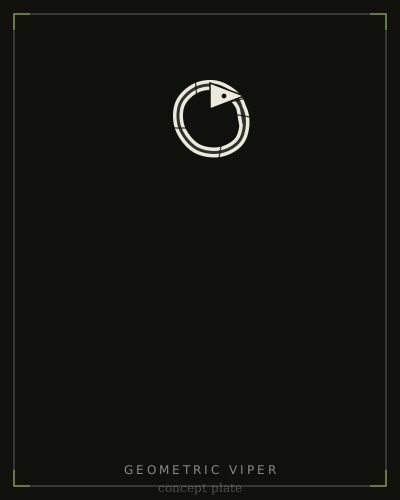
 Original plate
 Original SnakeTattoos concept plate illustrating the style.
Style guide
Geometric
The serpent, engineered.
Geometric tattooing rebuilds the snake from lines, facets and sacred-geometry patterns. A geometric snake is architectural — part animal, part diagram. It suits people who love precision, symmetry and the tension between the organic curve and the straight edge.
What defines it
- Clean lines, sharp angles, precise symmetry
- Faceted, low-poly or prismatic rendering
- Mandalas, polygons and repeating patterns
- Strong structural composition
How snakes behave here
The snake is drawn as a series of facets or line segments that still read as a serpent silhouette, or a snake wound through geometric shapes. The head is often the most detailed element.
Where the detail works
Detail is mathematical — the exactness of angles and the symmetry of patterns.
Best sizes
Small to large. Scales well because it is pattern-based.
Common combinations
Sacred geometryMandalasFloralsMoon phases
Good placements
This style reads best on these areas:
What to ask your artist
- How will you keep the facets aligned as the snake curves?
- Will you use a stencil or freehand the geometry?
- How will the pattern flow with my limb?
Honest limits
Geometry demands precision — a wobbly line is far more visible in this style than in loose illustration. Symmetry is unforgiving.
Explore the style
Read more in the field guide, or start a concept in this style.
Related designs
See all → Original plate 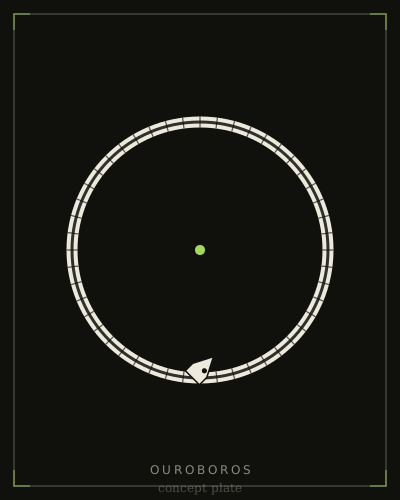 Original plate
 From vague idea to a concept you can take to an artist.
Explore the library, save what moves you, then build a direction — style, species, placement, size and mood — and turn it into a brief.