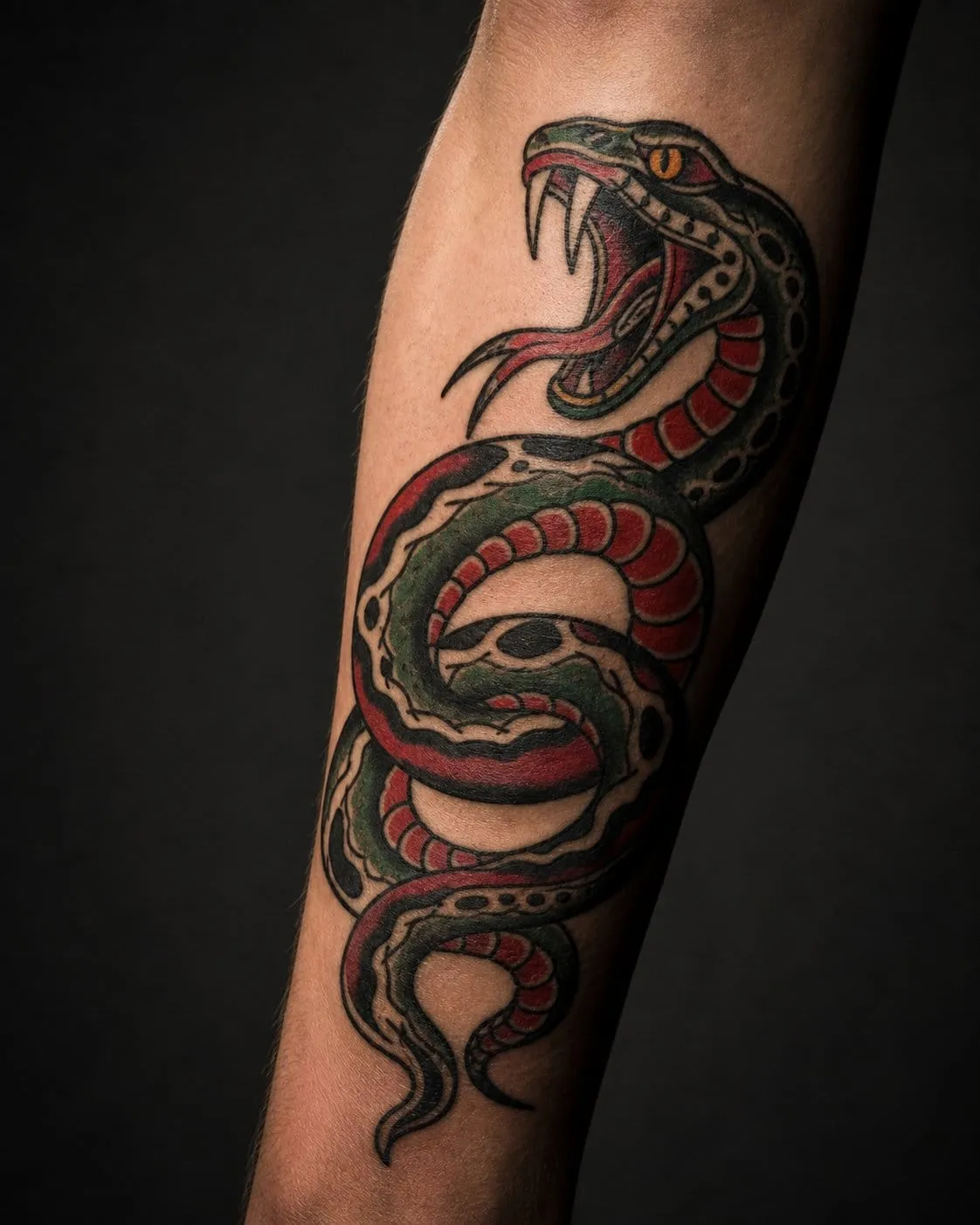
 AI concept
 Style guide
American Traditional
Bold lines, hard black, primary colors.
American traditional is the bedrock of Western tattooing — a language of thick black outlines, solid color packed flat, and compositions that read clearly from across a room. A traditional snake is a coiled, confident creature: you know what it is instantly, and it will still read that way in thirty years.
What defines it
- Heavy, uniform black outlines
- Solid, flat color with no gradient blending
- Limited palette — black, red, green, yellow, brown
- Compositions built from clear, iconic silhouettes
How snakes behave here
Snakes are usually shown coiled or wrapped around a dagger, rose, skull or eagle. The head is raised and open-mouthed or flicking a tongue, with exaggerated fangs. Scales are simplified into bold repeated shapes rather than realistic texture.
Where the detail works
Bold shapes, not fine detail. Detail lives in the pattern of the scales and the negative space between coils.
Best sizes
Small to large. Reads well at palm size but shines as a medium forearm, calf or chest piece.
Common combinations
DaggerRoseSkullEagleBanner textHearts
Good placements
This style reads best on these areas:
What to ask your artist
- Can I see healed traditional snakes you have tattooed?
- How will you balance the coils so the silhouette stays readable?
- Which colors will hold up best on my skin tone?
Honest limits
Traditional work is deliberately low-detail. If you want photorealistic scale texture or fine-line delicacy, this is the wrong style — its strength is legibility and permanence.
Explore the style
Read more in the field guide, or start a concept in this style.
Related designs
See all → AI concept  Original plate
 From vague idea to a concept you can take to an artist.
Explore the library, save what moves you, then build a direction — style, species, placement, size and mood — and turn it into a brief.