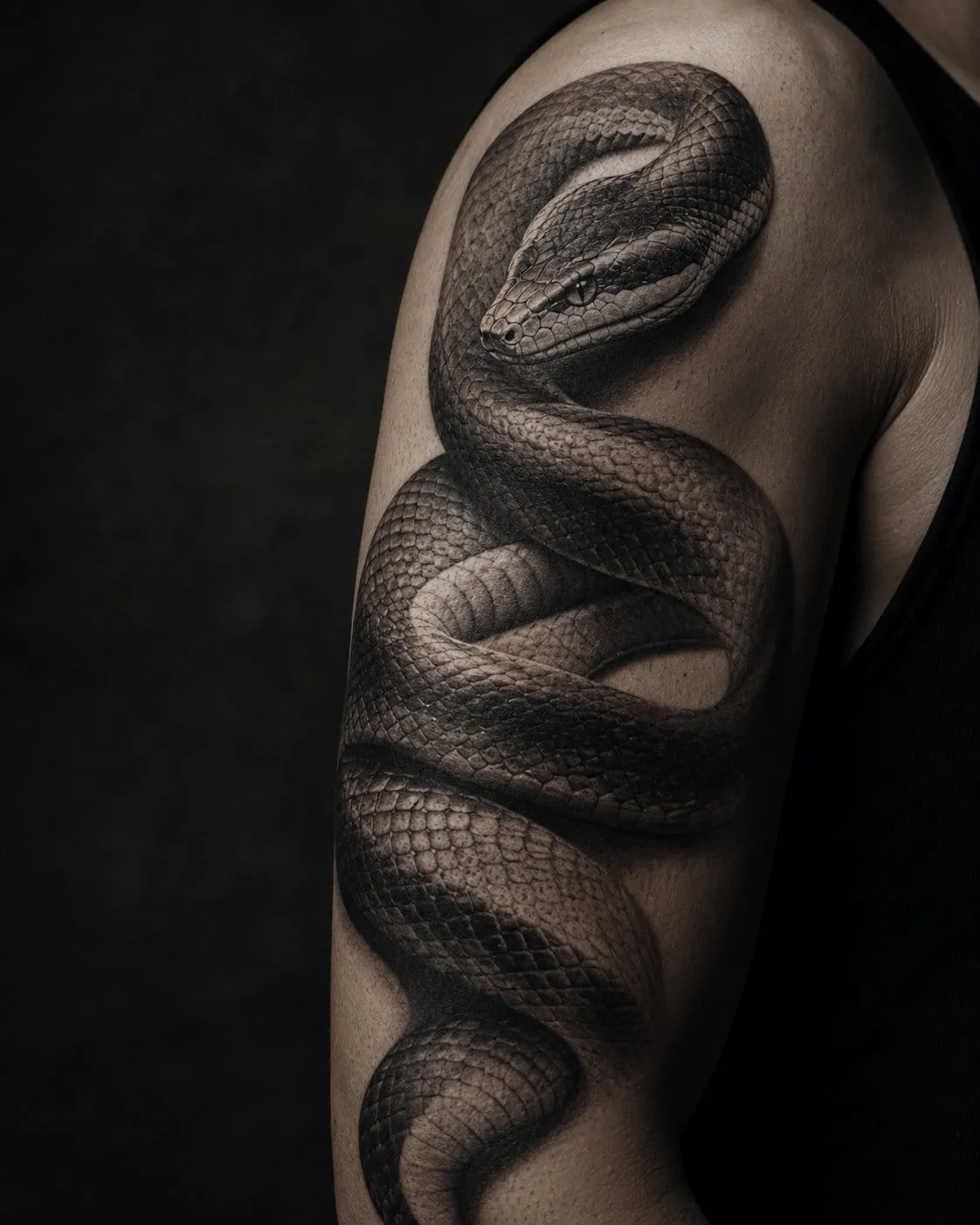
 AI concept
 Style guide
Black & Grey
Shading does all the talking.
Black-and-grey tattooing builds form entirely from black ink diluted into washes of grey. It is the middle ground between bold linework and full realism — soft, dimensional, and timeless. A black-and-grey snake relies on smooth gradients to give the body weight and motion.
What defines it
- Gradients from solid black to open skin
- No color — tone is everything
- Soft, smooth transitions
- Range from soft illustrative to near-photorealistic
How snakes behave here
Snakes are shaded for dimension: darker along the belly edge, lighter on the curve of the back. Coils overlap with soft shadows so the body reads as round and interwoven.
Where the detail works
Detail is tonal rather than linear. Smoothness of gradient matters more than the number of scales.
Best sizes
Medium to large — needs room for smooth transitions.
Common combinations
RoseSkullDaggerClockPortrait elements
Good placements
This style reads best on these areas:
What to ask your artist
- How do you build your greys — do they heal cool or warm?
- Where will you push contrast so it does not heal flat?
- Can I see aged black-and-grey work?
Honest limits
Low contrast heals into a grey smudge. The best black-and-grey has real black anchors and true skin breaks.
Explore the style
Read more in the field guide, or start a concept in this style.
Related designs
See all → AI concept  Original plate
 From vague idea to a concept you can take to an artist.
Explore the library, save what moves you, then build a direction — style, species, placement, size and mood — and turn it into a brief.