 AI concept
 Style guide
JapaneseHebi
Wind, water, and the guardian serpent.
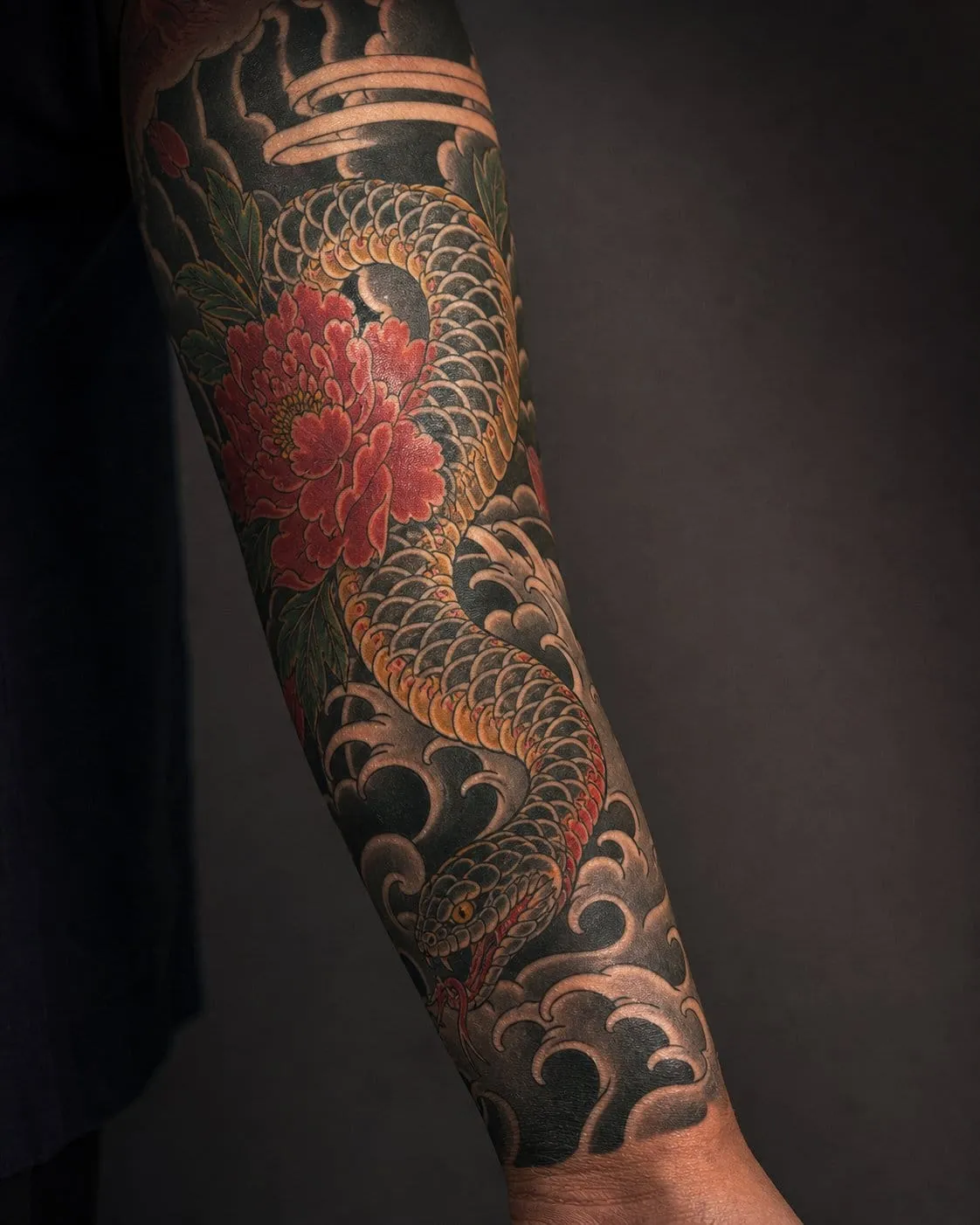
In Japanese tattooing the snake — hebi — is a guardian and a bringer of good fortune, tied to water and change. Japanese snakes are long, flowing, and built into larger compositions with waves, clouds and peonies. The style favors bold color, wind-bar backgrounds and strong diagonal movement.
What defines it
- Large-scale, flowing compositions
- Backgrounds of waves, wind bars and clouds
- Saturated color against heavy black
- Seasonal pairings, especially peony and chrysanthemum
How snakes behave here
The snake is typically shown full-length and in motion, tongue out, sometimes coiling around a peony or a skull. Scales are rendered in a repeating, decorative pattern. Eyes are often small and fierce.
Where the detail works
Scales are pattern rather than realism. Detail concentrates in the background texture and the head.
Best sizes
Large. Japanese snakes are full-flow pieces — sleeve, back, thigh or leg wrap.
Common combinations
PeonyChrysanthemumWavesHannya maskSkullCherry blossom
Good placements
This style reads best on these areas:
What to ask your artist
- Do you specialize in Japanese tattooing, or is this outside your lane?
- How will the background tie the snake to my body shape?
- Which parts should stay black and grey, and where should color go?
Honest limits
Needs a large canvas and an artist genuinely trained in the tradition. A Japanese snake squeezed into a small spot loses its entire grammar.
Explore the style
Read more in the field guide, or start a concept in this style.
Related designs
See all → AI concept  Original plate
 From vague idea to a concept you can take to an artist.
Explore the library, save what moves you, then build a direction — style, species, placement, size and mood — and turn it into a brief.