Placement · 8 min read
Snake Tattoo Placement: Where Snakes Flow Best, and Why
Why the snake is the most body-shaped tattoo subject there is — and how to pick the placement where your design will actually work.
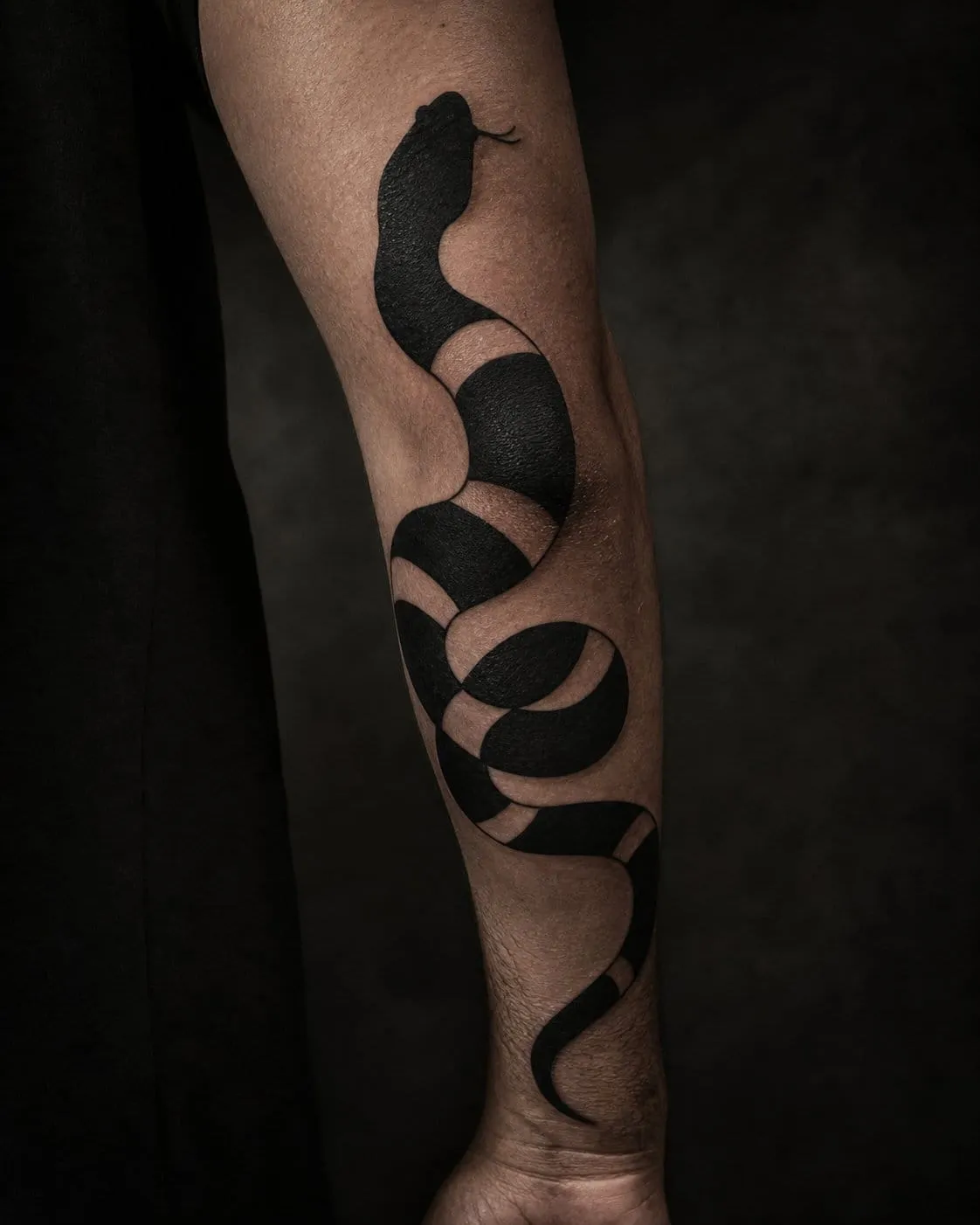
Snakes are the most placement-hungry subject in tattooing
Most tattoo subjects are flat images pressed onto a curved body. A snake is different: its body *is* a line, and your body is a series of lines — limbs, spine, ribs. That is why snake tattoos are so often wraps and flows: the animal and the canvas share a geometry. Getting this right is the difference between a design that sits on you and one that moves with you.
The three placement shapes
Cylinders: forearm, upper arm, calf, wrist, ankle, thigh. Built for wraps — the snake coils around and the body’s curve makes it look three-dimensional. The wrap is the snake tattoo’s home turf.
The vertical axis: spine, ribs, sternum, shin. Built for S-curves and rising serpents — the snake travels along the body’s own line. This is where fine line, ornamental and the "kundalini rising" image live.
Broad canvases: back, chest, thigh, sleeve. Built for full scenes — a serpent weaving through florals, waves or skulls with room to be epic.
Size sets the ceiling for detail
This is the rule people most often break: detail needs area. A realistic python needs a thigh or a back; on a wrist it becomes a grey smear within a few years. A fine-line S-curve is perfect on a wrist and lost on a back. Match the style’s detail requirement to the placement’s size before you fall in love with a reference photo.
Movement and joints are the hidden constraint
Your body is not a wall. A bicep changes shape when you flex; a calf changes when you stand on your toes; ribs move with every breath; the elbow and knee crease and fold. A good artist places the design for a neutral pose and designs the snake so its coils do not distort grotesquely when you move. This is why "it looks great in the photo" is not enough — photos are frozen, you are not.
Visibility is a real decision, not a vibe
Forearm, hand and neck are public; upper arm, thigh and back are private until you choose to show them. There is no wrong answer, but there is a wrong *assumption*: a neck or hand snake is a permanent public statement about body-modification culture, full stop. If that is what you want, great. If you are not sure, start private — the snake can always travel toward the light later.
How to actually decide
Think about when you want to see it (every day? only in summer?), what you wear (work shirts? shorts?), and your comfort with the session (ribs and shins are famously intense; thigh and outer arm are gentler). Then bring two placement options to your artist — not one. The artist will tell you which one the design actually wants.